
Nature heals and supports us. Gives us space to think, to bring all of the parts of ourselves together. It allows us to escape from worry and fills up our souls. In a less lyrical sense, we refer to this as ‘improving our wellbeing’, but I think sometimes the phrase doesn’t capture the depth of what nature does for us in this way. It can bring back memories, ground us to the present or set us free.
My grandmother, a wonderful and eccentric being, adored wildlife and found solace in nature, whether tending the plants in her garden, watching and being with animals, or travelling the world with my grandfather. She found people difficult, but nature was easy, a place where she could truly be.
It was hard for everyone when she moved into a nursing home, especially for her, and I won’t dwell on that time here. The first time I saw her truly relaxed there, she was sat by the window watching the birds - or rather, the notorious squirrel. My auntie had placed a bird feeder just outside the window, and Mar was in a battle with the chubby squirrel intent on stealing the seed. A battle she was very much enjoying. As we sat together, she provided an ad-hoc commentary on its movements, often pausing to laugh at its antics. Eventually, she banged on the window to scare it off so the birds could feed, though her sly smile showed she knew it would be back and I think she was secretly pleased it would be.
To see her content and laughing was more than I’d expected at that point, but the birds and squirrel had managed to unlock her. Later, the nursing home garden became her haven. Whenever I visited, she would be excited to go for a walk and show me the garden, even on the ‘no’ days when getting out of bed didn’t seem an option. Getting up and ready wasn’t easy and we wouldn't spend ages outside, especially if the weather was cold, but her eyes always sparkled if one of us suggested going out there and once in the garden, the comforting silence would enwrap both of us as we sat together, relaxed and chatting about anything and everything.
Seeing what the garden gave to Mar, someone who had experienced so much of life, yet at possibly the most difficult time of hers, this simple, little nursing home garden allowed her to find comfort, relax and unlock, and through this time when memory was a fickle being, some of the trees and flowers would trigger thoughts and memories for her, quietly and gently bringing parts of her back to herself. I’ve grown up knowing the power of nature, but seeing Mar go through this impossibly hard journey, someone I adored, and seeing how much it helped her, well, it confirmed what I thought I already knew but to another level.
The awful truth is that not all of us have regular access to the natural world. I think it’s important that when that’s the case, nature should be brought to those who can’t easily get out to enjoy it. One of the ways I’ve found of doing this is through Nature Hour sessions in Care Homes. Whilst Mar rarely enjoyed group activities, many people do enjoy them, and I’ve found bringing nature into these can be really successful. Through Nature Hour, I have witnessed some of the same benefits I saw in Mar with her garden.
The activities themselves are not grand or complex. Just simple, humble moments that may not look impressive, but I think can be really important.
.jpg)
“Wild Oxfordshire helped our residents rediscover the joy of nature through hands-on creativity. Crafting with natural resources brought calm, conversation, and a sense of wonder to our care home. Our residents now really look forward to the sessions and seeing Rhiannon and we appreciate the time she puts into preparing and hosting the mornings.”
Nature triggers memory, whether it’s the scent, feel or appearance, natural materials can transport our minds. In one of my sessions, we were making winter tree tiles using sticks pressed into clay to celebrate the silver birch in January. We had some lovely discussions on what trees meant to people. In particular, rather than creating an image of a tree, one participant decided to copy, from memory, a carving he had once made. The trees had reminded him of when he carved his and his wife’s initials into a love heart on an oak tree 70 years ago. I remember the smile and twinkle in his eyes as he told me this precious memory, and it led to us talking about their trip to Sydney where he’d done the same thing on harbour bridge and I, unwittingly many years later, must have walked past it! These were memories and a discussion neither of us had expected and yet they were triggered from some sticks, clay, and images of winter trees.
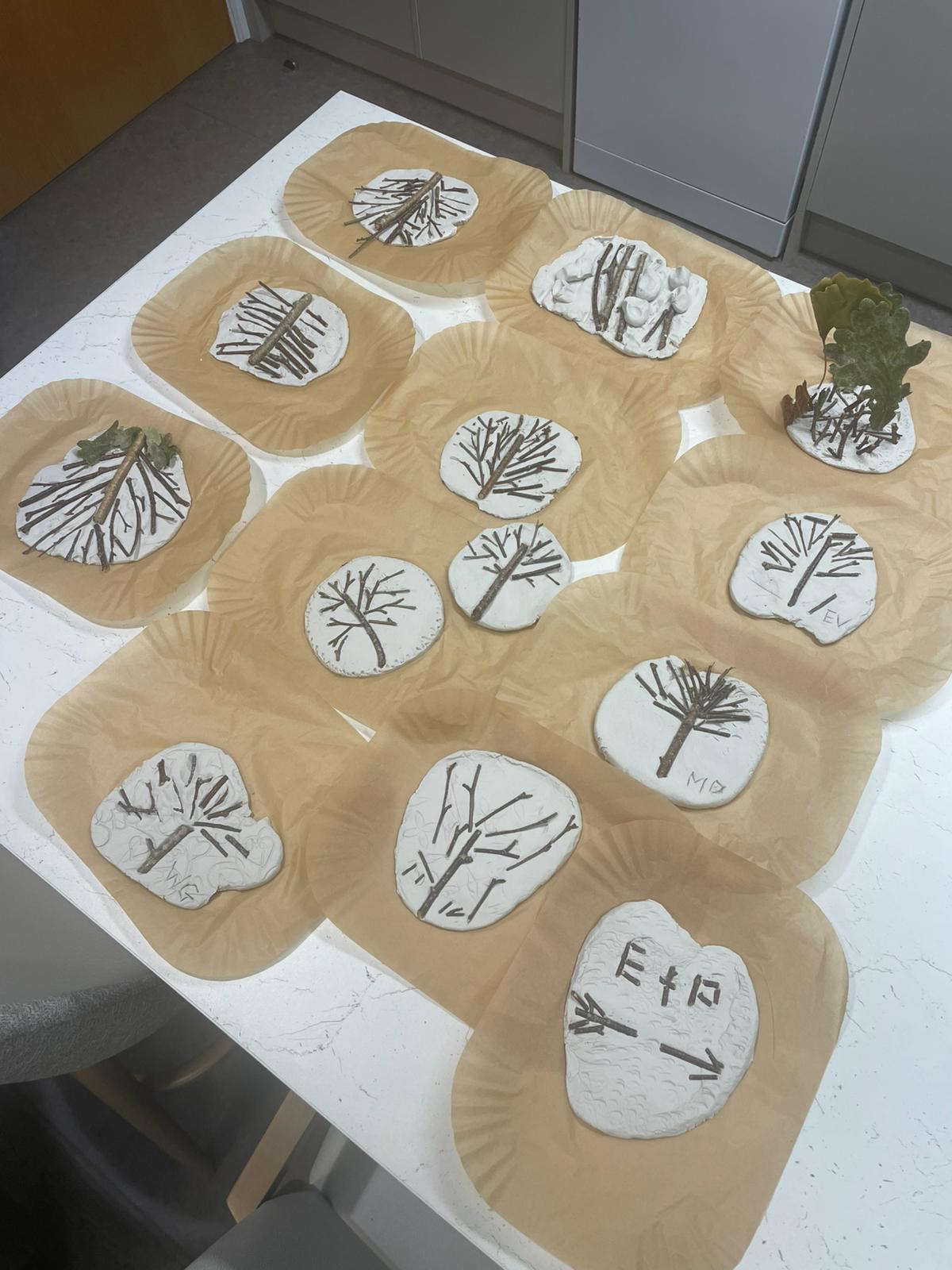
Part of the joy of these sessions is their unpredictable nature. They usually spark either laughter (such as when I did a “hedgerow hair” picture collage session and some of the residents decided to take the title quite literally for the fun of it and we giggled at each other’s rather fetching hedgerow adornments), or quiet contemplation and concentration, but they are always uplifting. The tactile nature of natural materials seems to bring comfort, and they also help with motor skills. With items like leaves, pine cones or conkers, people seem to savour the feel of them, running them through their fingers, and enjoy the experience of choosing them. These items also provide at talking point to bring residents together: “Did you know....”, “We used to pick these with my mum”, “We used to play a game with these!”, “I really like…”, “and so on.
Nature activities can be enjoyed by everyone – I think it’s often about how the activity or topic is presented rather than the activity itself. There are many, easy nature activities advertised for children, but I have learned that many of these are actually enjoyed by all ages and abilities. My first experience of this in my current role was in a session I was leading making hedgehog highway signs for gardens. The children had finished decorating theirs and went out to play. Whist they were outside, I had members of staff come and ask me if they could do one too. I ended up with an ad-hoc session, solely with the adults, enjoying making their hedgehog signs. Another memorable moment was when a police officer asked to do my mindful nature activity whilst on a break and told me, “This is so relaxing and calming” and happily spent a few quiet moments crafting before returning to their work.
Another way of proving an accessible nature activity that can be enjoyed by anyone, is to grow things. The earth connects us all. Refugee Resource have told me of the healing and reassuring nature of growing plants a sit is an, almost, entirely universal skill all over the world and in so many cultures. Even when everything else in unfamiliar, the earth itself can provide familiarity and connecting with it can be incredibly healing and by nature, grounding. Even if it’s just sowing seeds or creating a window box, this is another way of doing a nature activity.
So, if you know of someone that could do with a bit of nature in their lives, why not bring a bit of the natural world to them? At Wild Oxfordshire we’re all about restoring nature, but it’s important not to forget that nature can restore us too.
Rhiannon’s staple box of tricks:
- Air dry clay
- “Interesting” Natural materials (foraged from greenspaces)
- Paper
- PVA glue
- Pinecones
- Leaves
- Sticks
- Nature cards, books and images


.jpg)